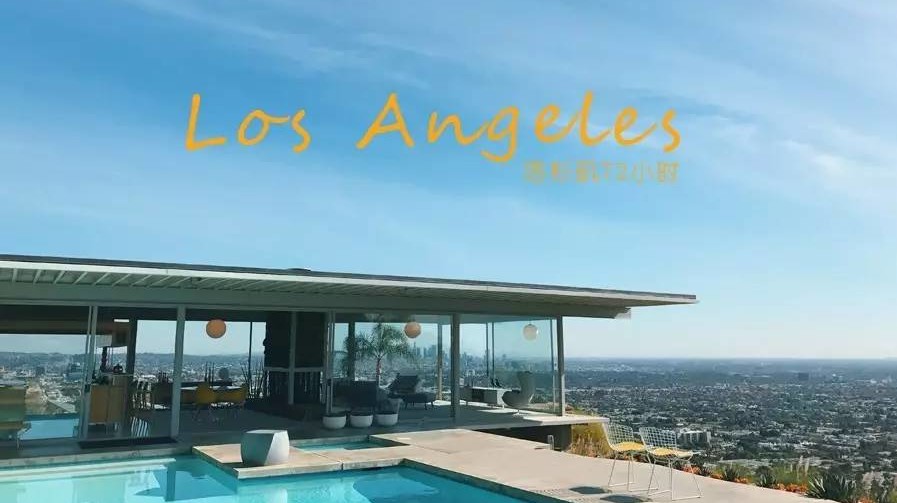
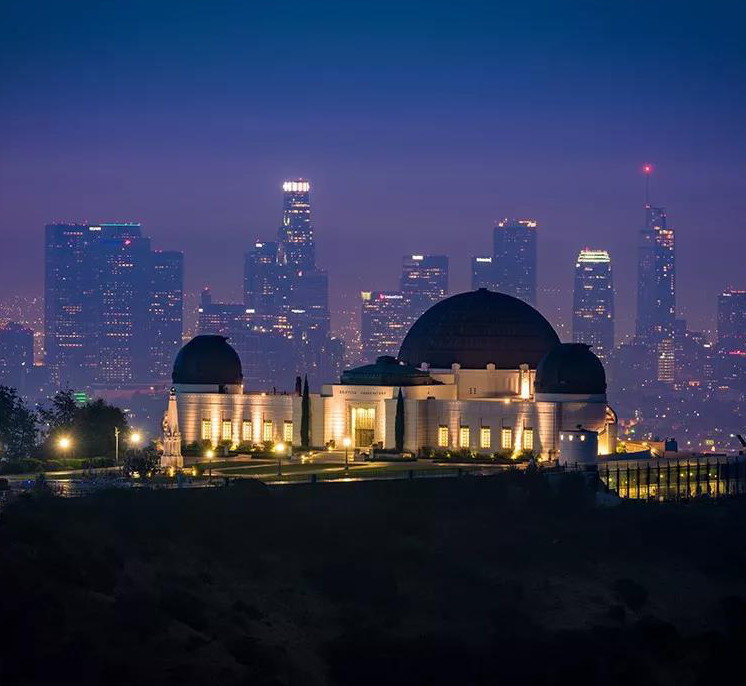
Los Angeles is best treated like a city of images rather than a check list of places to visit. Some locations offer opportunities for well thought out compositional photographs, while others are destinations due to their unique structure or surrounding culture which is greater than the photograph itself. These five destinations offer opportunities for both, although occasionally the rewards are unbalanced.
The Paul Smith Pink Wall, located 8221 Melrose Avenue is the obvious starting point. It's bright pink coloring juxtaposed to the ever present California blue sky is simplicity well worth the photo, which is why so many people love it. Visitors to the wall face a choice more challenging than simple composition: how do you avoid being captured in a photo that looks exactly like everyone else's?
Casual denim, a cropped shirt, and sun-kissed tones help to match the wall's bold color, but will leave you overwhelmed and hidden in the photo. When the sidewalk is crowded, using flowers or balloons for additional distraction helps when opting to shoot from a lower angle or use a tight frame to include only the surrounding shadows and outer edges of the sidewalk.
Universal Studios Hollywood located at 100 Universal City Plaza is a less convincing attraction for avid thrill seekers. When compared to the other Universal parks, guests may find some of the rides and attractions less exciting, and more screen based. The park does other things well such as The Simpsons and Minions photo ops, The Studio Tour, and set pieces from various movies like the Wizarding World of Harry Potter. The oversized donut, the giant Harry Potter themed sweets, and the refillable souvenir cups add to the performance. Other experiences at the parks, like the wand experience, which lets you purchase interactive wands and use them to activate cool effects at certain locations, make the walk back to the parking lot more costly. The plush owls in the Wizarding World of Harry Potter are also quite tempting. It is best to set a budget and prepare to give extra spending money, as Universal is designed to make guests spend money.
Taschen Gallery located at 8070 Beverly Boulevard has a more cultured take on visual theater in Los Angeles. The gallery is owned by the art-book publisher Taschen, which has Los Angeles bookshops located near Farmers Market and in Beverly Hills. The unique aspect of the gallery is its ever-changing facade. They regularly update the gallery and use the facade as part of the exhibit. You could see a bold, colorful wall with pop art one week, a different wall the next week with a different color scheme, and fashion photography the week after that. Past exhibits have also included work associated with David Hockney, who is also referenced in many of his American themed paintings, so he is especially relevant in Los Angeles. Photographer Ellen Von Unwerth has also been referenced in past work. The gallery openings have also attracted many celebrities to the event. However, the main attraction is their use of the building as a temporary work of art. You should visit if you have an open mind to the unpredictability of the design.
The Los Angeles County Museum of Art located at 5905 Wilshire Boulevard is deserving of more than a quick photo opportunity. It's large enough to require most of a day. It contains major collections and has outdoor exhibits that have become landmarks in Los Angeles. The grid of historic street lamps in the central plaza, which is called Urban Light, is the number one image. While it is a popular photo spot, if you get there early enough during the day you should be able to take your photo without other visitors in the shot. At night however the crowds can be heavier so visitors would be able to take their photos without other visitors in the shot.
The journey of Levitated Mass, Michael Heizer's 340-ton granite boulder, is described as the 'most substantial.' With a distance of 105 miles over 22 cities and four states, the boulder has an interesting story. Its location is complemented with a pass-under design, allowing for a unique appreciation of the boulder's scale, the weight, and human intervention. Another interesting visual stop is Rungo Thomson’s mirrored TIME cover, but only if the camera is held parallel to the reflective surface. As for temporary exhibitions, they can be equally interesting. Hence, instead of relying on social media images, visitors are encouraged to check exhibitions before arriving. The article listed the admission fee as US$15 for adults, and included closure days on Wednesdays, as well as free admission days. However, it is prudent museum users check updated hours and pricing before arriving. There is a fee for parking, and it is completely fine to decline optional donations.
The Getty Villa and Getty Center establish the best reason for viewing Los Angeles architecture. The Getty Villa located at 17985 Pacific Coast Highway, Malibu, is dedicated to antiquities and is modeled after the Villa dei Papiri in Herculaneum, a Roman villa that was buried due to the eruption of Vesuvius in 79 CE. The villa contains a Mediterranean-style construction with a courtyard, mosaic floors, symmetrical design, an outdoor theater, and other frescoes and tapestries of the era. The striking mosaic floors are very decorative without simply becoming an uninspiring background, and are one of the most memorable parts of the collection. There are also hands-on exploration areas, along with a highly regarded gallery of mummies.
The Getty Center is located at 1200 Getty Center Drive and is a contrast to the type of building located at the Los Angeles County Museum of Art (LACMA). Designed by architect Richard Meier and finished in 1997 after 13 years of construction at an estimated cost of $1 billion, the Center is reached from the parking structure by way of a free tram. Meier's use of pale travertine and bright white surfaces create a confidence above the city that still feels remarkably fresh. He also uses geometric forms and controlled natural light and designed the Center to be as much about spatial experience as the collections inside. In contrast to the dense energy of LACMA, the Getty Center feels open, quiet, and almost cinematic.
The Central Garden also invites visitors to walk, rest on the grass, or simply watch and enjoy the day's light as it shifts across the various architectural elements, while the institution even recognizes rolling down the garden lawn as a familiar pastime. This small, and rather unique detail shows that The Getty does not insist that art and architecture be treated as distant, untouchable monuments.
If the contrast experienced from Roman-inspired classicism at the Getty Villa, and the modernist clarity at the Getty Center is to be truly appreciated, it is best done in a single day's visit to both locations. This article states that parking at each of the Gettys can be done in one transaction if done on the same day, although it is advised to check this policy prior to parking. More than any perfect photograph, the passage from ancient forms to Californian modernism captures what makes Los Angeles so visually restless and rewarding.